


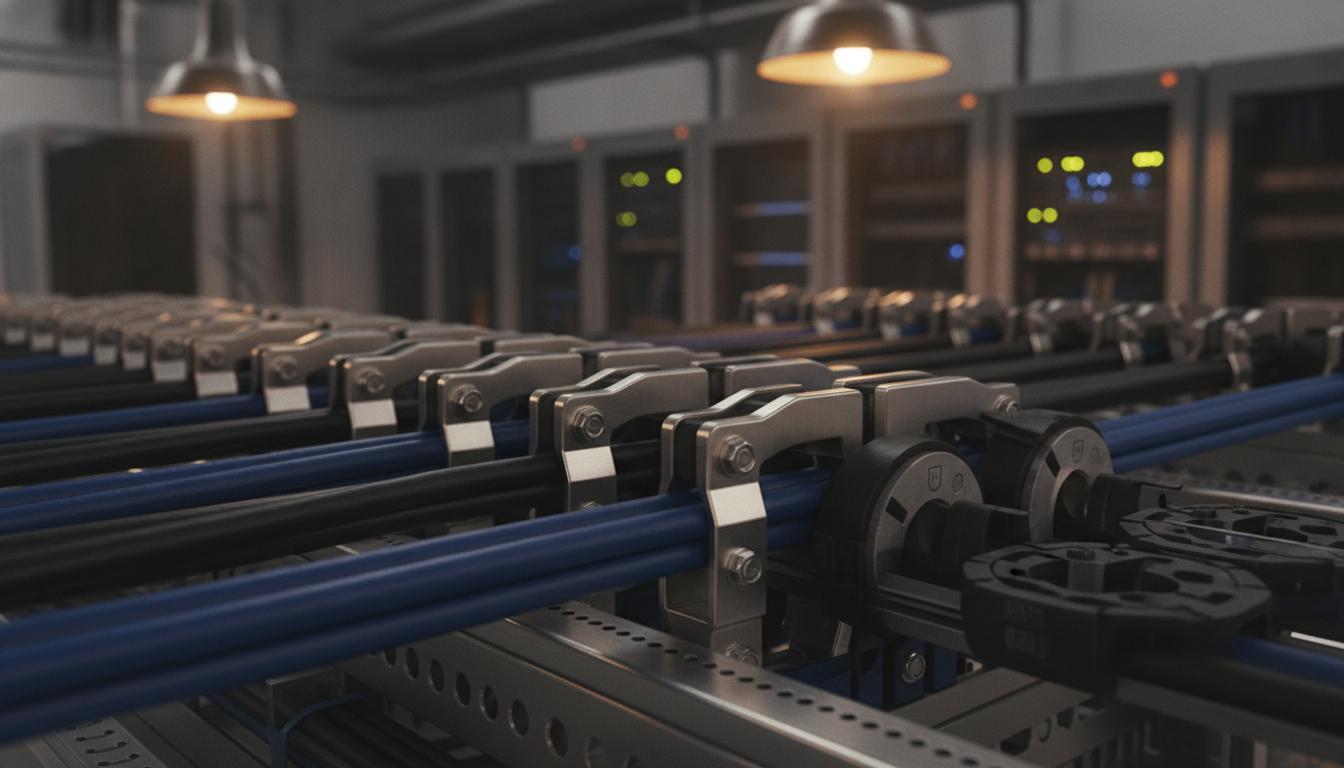
The U.S. market for electrical infrastructure continues to face higher demands in 2026 around grid reinforcement, data centers, offshore energy, and industrial electrification. As a result, the focus in cable support is shifting from purchase price alone to proven performance under load. For electrical infrastructure engineers, this means stainless steel cable clamps cannot be judged on unit price alone, but on material behavior, certification, mounting configuration, short-circuit withstand, and total lifecycle cost.
Stainless steel cable clamps are often chosen because stainless steel is mechanically strong and appears resistant to aggressive environments. Still, price comparison is less straightforward than a quote sheet suggests. A clamp that looks favorably priced on paper can turn out more expensive in practice because of galvanic corrosion, conductivity, longer installation time, additional insulating components, or limitations in short-circuit performance. Anyone comparing stainless steel cable clamps with plastic cable clamps should therefore look not only at the material, but at the full function within the cable management system.
Why the price of stainless steel cable clamps can vary widely
The price of stainless steel cable clamps is driven by several technical and commercial factors. Stainless steel is not a single material. A product in AISI 304 has different properties than one in AISI 316 or duplex stainless steel. For installations in coastal areas, offshore environments, or industrial atmospheres, a higher alloy grade is often required. That raises not only the material price but also the machining costs.
Production method, wall thickness, surface treatment, and fastening method also play a role. A simple cable clamp for a light industrial application sits in a different price class than a heavy-duty cable clamp for medium- or high-voltage installations. With larger diameters, not only does the volume of material increase, but so does the required mechanical stability. As a result, the price usually does not rise linearly with cable diameter.
This matters for engineers because a comparison based on “price per clamp” gives a distorted picture. A more expensive stainless steel cable clamp can be economically justified if it demonstrably meets the mechanical requirements of the installation. Conversely, a low-cost clamp can be unsuitable when the short-circuit forces, cable diameter, or environmental load fall outside the tested range.
Compare on specification, not unit price
When comparing stainless steel cable clamps, the technical baseline has to be aligned first. Without identical starting points, you are not comparing products, but assumptions. For electrical infrastructure projects in the U.S., the following parameters are the most decisive:
- Cable diameter and tolerance range
- Single, trefoil, or modular configuration
- Expected short-circuit current and dynamic forces
- Mounting spacing and support structure
- Environment: indoor, outdoor, offshore, rail, tunnel, or industrial site
- Fire behavior and smoke emission
- Electrical conductivity and risk of unwanted current paths
- Certification to the relevant standards and test methods
A cable clamp block suitable for low-voltage distribution may be unsuitable for a high-voltage connection with heavy short-circuit loads. Likewise, stainless steel clamps for cables may be mechanically strong, but may require additional insulating components when galvanic interaction or conductivity poses a risk. Those additional components belong in the price analysis.
KOZ Products approaches cable fixing from the standpoint of certified plastic fixing solutions. The cable clamps and cable blocks are developed for low-, medium-, and high-voltage installations and are certified to NEN-EN-IEC 61914:2021. In a comparison with stainless steel solutions, this is relevant because the conversation shifts from material preference to demonstrable performance in the installation
The hidden costs of stainless steel cable clamps
The initial purchase price is only one component of total project cost. With stainless steel cable clamps, additional costs can arise that only become visible during engineering, installation, or maintenance.
Installation time is the first factor. Heavier clamps can require more handling steps, especially in serial installation in cable trays, tunnels, or utility galleries. When insulating spacers are needed, the number of components per fixing point increases. The logistical impact can also grow because of higher weight per packaging unit.
The second factor is material interaction. In certain configurations, stainless steel can lead to galvanic coupling with other metals. In humid or salt-laden environments, the material combination must be assessed carefully. That means the price of the cable clamp cannot be viewed separately from the fasteners, support structure, and cable sheath.
The third factor is inspection and maintenance. If the installation environment is aggressive, stainless steel components must be checked periodically for pitting corrosion, crevice corrosion, or contamination around contact surfaces. Not every stainless steel grade reacts the same way. A higher alloy grade can reduce these risks, but it again raises the purchase price.
When plastic cable clamps are a technical alternative
Plastic cable clamps are not intended as a generic replacement for every stainless steel application. They are a technical alternative when insulating properties, low conductivity, material resistance, and certified short-circuit performance weigh heavily in the design decision. KOZ Products manufactures cable clamps and cable blocks from high-quality plastic materials, with a diameter range of 11 mm to 160 mm (0.43 in to 6.3 in) across the product range.
Using plastic in electrical infrastructure offers specific advantages. The material is non-conductive and non-magnetic, which limits unwanted electrical or magnetic effects. In addition, KOZ cable clamps withstand temperatures from -80°C to +120°C (-112°F to 248°F), briefly up to +220°C (428°F), and product claims regarding fire safety are backed by official certifications such as UL94 V-0 and EN 45545-2:2020.
For high-voltage cable clamps, short-circuit withstand is not a theoretical criterion. During a fault current, electromagnetic forces arise that can pull cables out of position. This is why certification to NEN-EN-IEC 61914:2021 is a deciding factor in the technical comparison. KOZ Products cable clamps are developed for applications where this type of performance requirement is central.
Assessing prices within total lifecycle cost
Electrical infrastructure engineers prefer a total cost of ownership approach. The price of stainless steel cable clamps is compared with the costs of design, installation, inspection, replacement, downtime, and risk. In that model, a product with a higher initial price can still be more economical if it requires fewer additional components or fits the installation requirements better.
A practical comparison method has three layers. First, technical suitability is tested. Does the cable clamp meet the requirements for diameter, configuration, short-circuit load, and environment? Next comes the installation layer. How many fixing points are needed, what mounting spacing is prescribed, and how much time does each fixing take? Only in the third layer is the financial comparison made.
On large projects, a small price difference per cable clamp can weigh heavily, especially with hundreds or thousands of fixing points. Still, that difference must not be separated from proof of performance. Buying a cable clamp without verifying the test basis and application limits can lead to higher costs through redesign, inspection rejection, or rework on the jobsite.
Considerations for U.S. projects
For projects in the U.S., local design practices, project documentation, and inspection processes play an important role. Engineers often need to translate requirements into project specifications that clearly describe standards, test criteria, and material behavior. That takes more than a generic description such as “stainless steel cable clamps.” The specification should state why stainless steel is required, or what performance the clamp must deliver.
On international projects, a tension regularly arises between a material requirement and a performance standard. A specification that calls for stainless steel may be intended to ensure robustness or corrosion resistance. If a certified plastic system delivers the same or better functional performance for the application in question, it deserves a technical evaluation. This applies especially to electrical cable clamps where insulation behavior, short-circuit withstand, and installation flexibility carry significant weight.
KOZ Products is based in Goes, the Netherlands, but operates internationally. For engineering teams in the U.S., the combination of product range, certification, and customization is particularly relevant. The product lines include single cable cleats, trefoil cable cleats, and modular cable blocks for a wide variety of cable configurations. For project-specific questions, engineers can draw on KOZ Products’ technical advice on application and selection.
How to build a proper quote request
A reliable price comparison starts with a complete technical request. The more accurate the input, the more useful the quote. For both stainless steel cable clamps and plastic alternatives, the request should include at least the following:
- Cable diameter, cable type, and tolerances
- Number of cables per configuration
- Single, trefoil, square, or modular arrangement
- Expected short-circuit current and duration
- Mounting spacing and support structure
- Indoor or outdoor installation
- Exposure to UV, salt, chemicals, or vibration
- Required certifications and test documentation
- Project volume and desired delivery schedule
Without this information, comparing cable clamps seems simple, but technical equivalence is missing. A quote with a lower unit price can ultimately prove more expensive if additional parts, modified drilling patterns, or extra engineering are needed later. Conversely, a complete fixing solution with cable blocks or certified cable clamps can reduce project risk.
From material price to installation certainty
Comparing stainless steel cable clamps requires a broader analysis than laying price lists side by side. Stainless steel has clear merits in mechanically demanding and corrosive environments, but it is not automatically the best or most cost-efficient choice for every electrical installation. For electrical cable clamps, short-circuit withstand, insulating behavior, fire classification, and certification are at least as decisive as material strength.
KOZ Products does not provide on-site installation, but develops and manufactures high-quality plastic cable clamps, cable blocks, and support systems for demanding infrastructure. For engineers who want to compare stainless steel cable clamps with plastic fixing solutions, the value lies in objective specifications: a diameter range of 11 mm to 160 mm (0.43 in to 6.3 in), certification to NEN-EN-IEC 61914:2021, flame-retardant properties per UL94 V-0 and EN 45545-2:2020, and material resistance for a wide range of industrial conditions.
A proper price comparison therefore does not end at the lowest line in the quote. It ends at a system that keeps the cables in place when the installation is under the heaviest load. For project-specific selection or a technical comparison between stainless steel cable clamps and plastic cable clamps, KOZ Products can provide support through product specifications, application advice, and customized solutions


